Learning & Resource Center
Case Study
Biotechnology Engineering Firm, Interventional Medical Devices
- 80-85% reduction in training costs
- Improved trainee attendance
- Eliminated cancellation risks
THE SCENARIO
Our client, a biotechnology engineering firm, is a global manufacturer of medical devices used in interventional medicine. Our client needs to provide exhaustive and highly specific training for doctors using their products, and for healthcare professionals seeking to inform their decisions about institutional product acquisitions. The most effective way to impart knowledge on these complex devices is by listening to the people who use them, i.e. doctors, where they use them, i.e. in the operating room.
THE CHALLENGE
Taking people to witness actual surgeries is complex, time-consuming, and expensive. Trainees need transportation to the location of each surgery, as well as adequate food and lodging. Coordinating surgeries and travel is subject to failure, for example in the case of cancellation of surgeries or flights. The costs of travel and lodging expenses can be entirely wasted if the surgery is canceled or postponed. And each trainee can only witness each surgery one time, so the while process needs to be repeated for each new learner.
THE SOLUTION
Working with the client, we designed separate training courses which would include all needed surgeries and classes. A specific number of surgeries, covering predetermined medical scenarios, was chosen for each training course. Working with their partners in healthcare, the client gave us the list of surgeries to attend. In each surgery, our specialized team used a combination of VR and traditional cameras to record the surgery, the medical instruments and the class given by the surgeons.
The video for each surgery immediately went into postproduction and was pre-edited by our medical specialists. We then worked with the client on each video, to produce one or more versions according to their training goals.
RESULTS
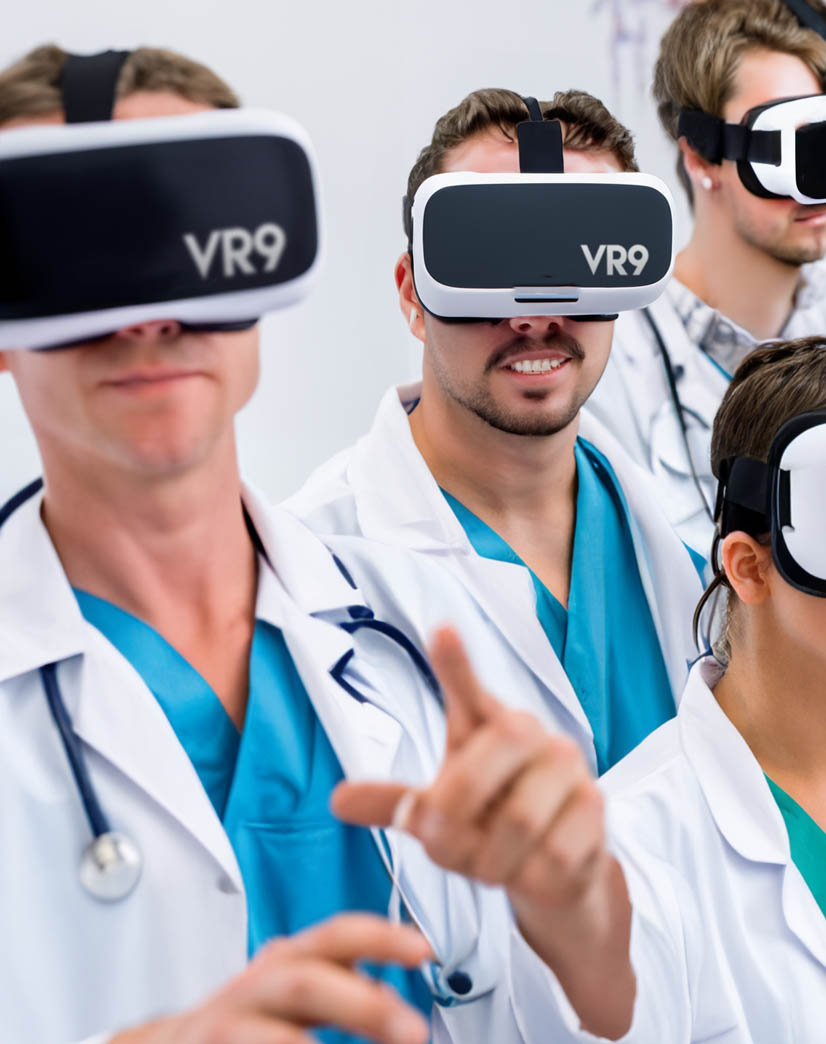
Classes were incorporated into the client’s e-learning platforms as separate videos or as part of larger training programs. By watching the surgeries in immersive VR, trainees could attend classes in the surgery room from wherever they were based; furthermore, each trainee could watch each class as many times as desired, and the client had the option to combine each class with a specific learning module such as an interactive questionnaire or online test.
MEASUREMENTS
The client was able to verify trainee learning using online tests and designated quantitative and qualitative feedback channels.
Cost of training dropped by 80-85%
Trainees profited from the possibility of viewing each surgery or clinical case multiple times, as verified by online metrics
The risk of trainees missing a class due to surgery cancellations or postponements dropped by 100%
Case Study
Medical Device Manufacturer, Interventional Cardiology
Qualitative feedback indicated:
- Animations and CGI visuals aided in understanding medical device concepts
- Narrative clarity in finished videos
- High viewer satisfaction with data presentation
THE SCENARIO
Our client, the educational division of a major medical devices manufacturer, needs to produce a complete training course for its line of interventional cardiology products. The finished course will cover everything from introductory material to specific clinical use cases. The client has amassed a large volume of material including doctor’s testimonials, medical literature and medical device outputs recorded during patient studies and surgical interventions. This material needs to be organized into educational videos and integrated in the client’s e-learning system.
THE CHALLENGE
The variety and sheer of volume of the recorded material, as well as the different types of training videos to be produced, called for exceptionally efficient client-facing project management to ensure a smooth process for writing and editing. Each video presentation would be written by various parties, including external medical experts, then adapted into a video script, edited, and re-edited for narrative clarity. Furthermore, time constraints would make it necessary to write and edit up to five videos simultaneously, seamlessly coordinating the various teams involved..
THE SOLUTION
We worked on the client on three focus areas: a new classification system for source materials and new content; an online interface to translate the client’s content into workable video scripts; and the visual style for the videos, which needed to integrate with the client’s existing content in their e-learning courses. Together with the client’s product managers, we designed a workflow to carry us over the next few months of video production. Since we would be working so closely with the client’s educational outreach specialists, we divided video post-production in organizational stages, refining the final workflow in meetings with stakeholders and taking joint ownership of the process.
When the writing and editing process began, the client’s staff was so familiarized with the workflow that they could concentrate solely on the content, without worrying about the logistics. Being able to quickly access source materials and new videos, they could effortlessly share them with their external sources and SMEs, then seamlessly incorporate their feedback into the editing process. Most importantly, they were able to detail content and highlights for each video and to revise the editing process, without needing to become familiar with video production.
RESULTS
Over the course of eight months, 25+ videos were written, produced, edited and incorporated into the client’s LMS systems. The client manifested that the new visual style not only integrated perfectly with the aesthetics of their e-learning courses, but also helped to more easily understand each video thanks to animated graphs and tables improved narrative flow. The new videos strengthened the client’s existing curricular content by providing general context and scholarly references in a clear, concise and visually appealing way.
MEASUREMENTS
The client verified the positive impact of their training courses by qualitative feedback in both online and in-person surveys.
- Using animations and CGI-generated videos of anatomy and device action greatly aided in understanding medical device concepts
- By including a broader context provided by recognized specialists, the videos took the courses to a new level and attracted a wider specialized audience
- Online surveys after each video indicated viewer satisfaction with the way data was presented
- Viewer comments expressed appreciation for the videos’ clarity, rhythm, and visual highlights of complex data
Case Study
Medical Device Developer, Therapy Devices for Structural Heart Disease
Live streaming surgical interventions resulted in:
- High degree of satisfaction with the practicality of information gathered
- Appreciation of valuable insights, which would have been difficult or in same cases impossible to attain otherwise
- A new perception of the clinical product, gained in a very short time
THE SCENARIO
Our client, a leading developer and manufacturer of therapy devices for structural heart disease, has completed the first FIM («First-in-Man») clinical trials for a new product, a valve for dry-tissue transcatheter aortic valve replacement (TAVR). In the first stage of the global clinical application of the valve, the company seeks to gather clinical intervention data in order to precisely evaluate product ease of use, interactions and application. Data and insights gathered during this phase will inform the pathway for determining design improvements for the next generation of the product.
THE CHALLENGE
Implementing a conscientious information-gathering process, the client had resolved to gather not only hard data but as much «soft» information as possible. The goal was to provide product engineers with the most realistic possible insights on product safety, technical success and ease of use in the operating room. Major challenges were determining how to accurately collect, structure and distribute data and information, covering every possible useful aspect for the company’s engineers, and at the same time minimizing additional workload for the interventionist teams using the product.
THE SOLUTION
Working with the client, we determined that product engineers could greatly benefit from live interactions with the medical teams using the product in real surgical interventions. This would complement the data collection processes already in place between the client and the medical teams for gathering hard data, providing the additional information the client’s engineers needed: a direct view of the product on the ground, with practical details provided by the medical team in real time.
For the next scheduled surgical interventions using the valve, we set up live streaming sessions with two-way communication between the operating room and the team of product engineers. In each surgical intervention, an immersive video camera was placed in the operating room. Each intervention was live streamed in a private session in the Metaverse over immersive video. The client’s engineering team was able to watch the intervention live, standing, as it were, next to the operating table. They could ask questions, request different views of the procedure and receive open comments from the medical team. A team of five engineers and product developers was able to virtually stand in one spot next to the operating table, commanding a privileged view of the proceedings.
RESULTS
In their later comments, the engineering team stated that watching the procedure live and in real time enabled them to arrive at observations and questions for the medical team that they otherwise would not conceived. For their part, medical teams were able to share their observations on product usability, performance and safety, and in the process gain insights into the rationale behind product design. Interventions and comments were recorded for later consultation by the teams. These live interactions between the teams were a unique opportunity for collaboration, and amply fulfilled the client’s goal for aligning an initial pathway for the next generation of their TAVR offering.
MEASUREMENTS
Qualitative assessment confirmed a high degree of satisfaction, in terms of practicality–the ease with which team members could formulate questions and receive answers–but also in the quality of the insights, both in questions and in feedback comments. This resulted in gaining a new perception on the product in a very short time. As one member of the engineering team put it, «We learned more about product interaction in three interventions than we could have assembled ourselves in months of reviewing feedback.»
Content
Development
OUR APPROACH
Content development begins by assessing a client’s strategic and specific educational/business needs.
We develop training courses from scratch, using a selection of the best available tools — multimedia, traditional 2D video, e-learning, graphics, etc. — and adapting to budgetary or time constraints. We can create specific audiovisual pieces for special use cases, such as seminars or events, in the physical world or in the Metaverse.
We repurpose existing content — for example, using preexisting 2D video to create new audiovisual pieces, immersive or otherwise. We adapt information from a clinical case or training manual and transform it into an animated video or graphic, and update existing content in consultation with SMEs.
We define our working process on a per-project basis. Whatever the scope of the project, we strive for a process that is precise and adaptive. Key elements are stakeholder interviews, solid content management and a continuity of followups.
Ultimately, the end goal of our working process is not content delivery and approval, but to provide the client with a robust solution for ongoing content governance.
Evolving Training Strategies
Education and training, specially pre-service education and in-service education to provide continuous upskilling on healthcare staff, is of the highest importance to ensure safer care.
As technology’s rapid evolution causes healthcare practices to constantly evolve, so too does it offer possibilities for developing and combining novel, updated training strategies.